The Story Of The Court Street Cemetery
Shannon Fojtik
TUCSON, Ariz. - While there may not be skeletons in the closets of central Tucson residents, there are probably 100 buried underneath each of their houses.
The Court Street Cemetery was created in 1875 and served as Tucson’s city cemetery, and the only cemetery, until its closing in 1909. It existed in the spot that currently includes the land north to south between Speedway Boulevard and 2nd Street, and east to west between Stone Avenue and Main Street, spanning eight city blocks total.
Now, the location consists of neighborhoods like Dunbar Spring, hotels and apartment buildings. What is unknown to most in the area is that underneath each property, there are still approximately 80 to 100 graves buried there.
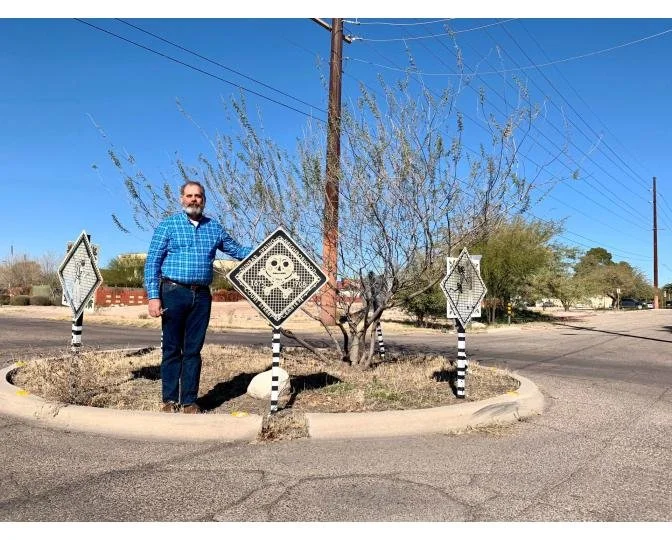
Homer Thiel stands where the Court Street Cemetery once existed.
Homer Thiel is a historical archaeology expert with Desert Archaeology Inc. and he is responsible for many of the excavations of bodies that were buried in what used to be the Court Street Cemetery. He has studied the area for years and says as many as 40% of the bodies that were buried there are still there today, unmoved from when it existed as the city’s only cemetery, where everybody buried their dead.
The secrets the Court Street Cemetery left behind were thought to lie buried forever, but over the years, those who remain are gradually found, whether it be on purpose through excavations or accidental occurrences that make their discovery possible.
“The next street over, Perry Street, a guy was digging a new post hole for his mailbox and hit a body,” Thiel said. “Then across the street, a sinkhole opened up in the sidewalk area, so [the resident] stuck his shovel in and hit a coffin. So about once, every other year, somebody finds somebody.”
According to Thiel, approximately 7,000 to 9,000 people were buried at the Court Street Cemetery, and because of the poor record keeping of the time, almost all of the stories of these people are lost forever.
So much comes from those who were buried and forgotten at the Court Street Cemetery, and would have been lost completely had it not been for various discoveries of graves throughout time on the land where the old cemetery resided.
Iva Louise Lard is one of those stories left behind. Iva was a little girl who lived in Tucson with her parents from 1907 to 1908. She was killed when she was only one year old from a bear bite and was buried at the Court Street Cemetery, according to her death certificate.
Besides her date of birth, her reason for death and the date of when her death occurred, nothing else is known about her. Her death certificate says the chief cause of death was “head crushed.” Her body was not moved when the Court Street Cemetery closed. Her resting place will most likely remain a mystery forever.
Walking throughout a cemetery is meant to make one feel a sense of eternity, with the quiet of the space meaning to exist to give those buried an ideally peaceful rest. The Court Street Cemetery only was able to attempt to give this environment to those resting there for 34 years and today, this concept is much different than the reality of what that land currently is used for.
The only marker in the neighborhood of Dunbar Spring, part of the area which used to be the Court Street Cemetery, that would cue anybody in on the land’s history is the sign located in the middle of two intersecting streets. The sign has a skull on it and says “Court Street Cemetery.” This stands as the only attempt at a memorial for the thousands whose bodies are still there.
Dunbar Spring is a neighborhood with dwellings of varying sizes and shapes, with details painted bright colors and various ornaments hanging from trees or porch rails. In some yards, there are religious shrines, in others, there are political-based signs. When walking throughout the area, one can expect elaborately painted fences, overgrown vegetation and artistically inspired, but historic-looking houses. The neighborhood is home to a wide variety of people and based off of the neighborhood’s online website and the shock from those who own homes in Dunbar Spring upon hearing about the Court Street Cemetery, most are unaware of what likely lies underneath the foundations of their homes.
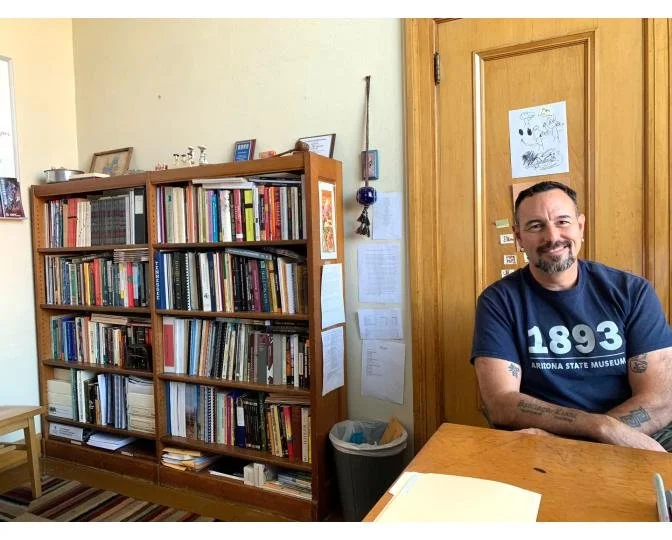
James Watson in his office at the Arizona State Museum
James Watson is an Associate Director at the Arizona State Museum and holds a Ph.D. in Anthropology. He has been responsible for the study of many of the bodies exhumed from the Court Street Cemetery and has worked on creating biological profiles for many of these individuals.
“Most of [the bodies], if they were not claimed, or if we couldn’t find anybody to claim the bodies, then they stay here at the museum,” Watson said. “These are some of the few [remains here] that are historic and not ancient.”
Those that were discovered and excavated from the Court Street Cemetery are difficult to identify, Watson said, and most of the time, doing this is almost impossible. He commented that the actual bodies themselves do not give hardly any clues at all as to who the people were during life because of the fact that they are only skeletons now and time has taken away and decayed anything that may have given a chance at having them identified in current times.
“There’s a big age range, and it’s tough to pin it down. This makes it tough to determine who may be who when it comes to the death records. We’d actually have more luck [identifying people], probably, based on where they were placed in the area.”
According to Watson, the benefits of studying these bodies can include more information about what life could have been like in the time period these people lived in. The bodies can indicate the health of the individuals, the ancestry and possibly pathology. This helps to create a clearer picture of what life could have been like, and Watson commented how the likelihood at more bodies being found from the Court Street Cemetery is great, and should anybody in the area find any kind of human remains, they are required to call 911 and inform the police.
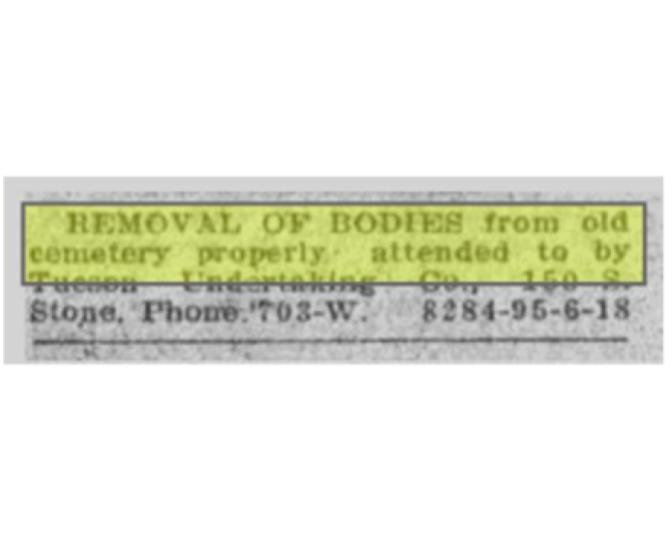
**The publication by the Tucson Citizen in 1915 advertising body removal services. From the Tucson Fire Foundation’s study on historic graves of firemen at the Court Street Cemetery.
When the Court Street Cemetery closed in 1909, the city’s minimal attempt at relocating the thousands buried there consisted of a small notice published in the Tucson Citizen, the main newspaper for the area at the time. The notice asked for people to remove their loved ones to Evergreen Cemetery, now known as Evergreen Mortuary and Cemetery, and provided them with contact to services able to relocate their buried relatives.
Most people did not have living loved ones to take this responsibility, or people simply could not afford the price to move the burials. As a result, all those people, and their stories with them, were left to be built over by a rapidly expanding and demanding city.
As shown by newspaper clippings from the time, the city of Tucson clearly had an issue with the Court Street Cemetery and articles from the Tucson Citizen describe it as “a harbor of filth [that] has become so great a nuisance” and that simply walking by the “old cemetery wall,” one would be met with “the stench-laden breezes that blow from the most unsavory quarter.”
Evergreen Mortuary and Cemetery is active today and has been ever changing since it took over as Tucson’s main cemetery when the Court Street Cemetery closed. It exists off of Oracle Road and short brick walls surround the east and south sides of the grounds. Tall, old headstones can be seen by drivers on the road. The patterns of the graves are not uniform and seem relatively random. There is a section of headstones underneath trees in the middle of the cemetery where most of those buried there died in either 1944 or 1945, possibly veterans of World War II as indicated by military emblems carved into their stones.
Turning onto the property, the mood instantly takes a depressing shift, but not because of the fact that thousands of graves, thousands of dead, buried people, are here, but because of the disrepair this still-active graveyard is in.
This cemetery is unique from others in Tucson for this reason, and while many of the graves are newer and are most likely maintained very well, many of the graves from the 1960s and before are cracked, faded or even being consumed by the earth itself.
On a rainy day, the sunken graves seem even more so and spots where visitors have accidentally had their feet sink into the mud near headstones are visible. Tree roots grow thick and engulf markers, consuming them and doing unknown amounts of destruction to the bodies that lie below.
There are many people who were moved when the Court Street Cemetery closed, but even then, walking throughout Evergreen, searching for those with dates of death between 1875 and 1909, less than twenty markers can be found. Either because of the ruin of tombstones or even the lack of tombstones altogether, identifying those with original resting places at the Court Street Cemetery is difficult.
When Evergreen took over the role as Tucson’s main city cemetery, those who were moved were often not handled well. Thiel said: “The ones that were moved, they mostly were digging up the bodies in the summer when it was hot, and you had to dig down to the wooden vault box, break that open. There would be the coffin, you then had to break the coffin. You’re down five or six feet, and they basically just grabbed the big bones. And so when we dig up the bodies that were actually exhumed, there’s always some hands and feet, and vertebrae. Sometimes they would only even grab the skull.”
Additionally, often times, aware of the fact that there was not a real way to know for sure whether bodies were moved or not, those who were hired to do so cut corners and would sometimes only move the headstone to the new location, Thiel added.
Existing stories from those who were buried at the Court Street Cemetery are few and even those that do exist do not have much detail. One man who was buried and relocated was Curtis H. Tarbox. His stone is lying flat on the ground in Evergreen and the name is almost so faded that soon, nobody will be able to read it.
According to findagrave.com, Tarbox was a single, caucasian man who lived in Tucson for 25 years leading up to his death. He worked as a bartender and was a member of the fraternal order called The Improved Order of Red Men. He commited suicide November 17, 1906, and now his resting place is recorded as Evergreen, but his actual resting place is likely different.
Those who were moved to Evergreen from the Court Street Cemetery all have one thing in common. They all are remembered now simply by faded, cracked and worn stones that sit, sinking into the ground.
Walking around Evergreen, anybody could find any one of these names, even though a couple will soon be unreadable. Anyone could pay respects to the places where these markers lie today, but to visit the actual resting places of these people would mean taking a trip back to the Court Street Cemetery.
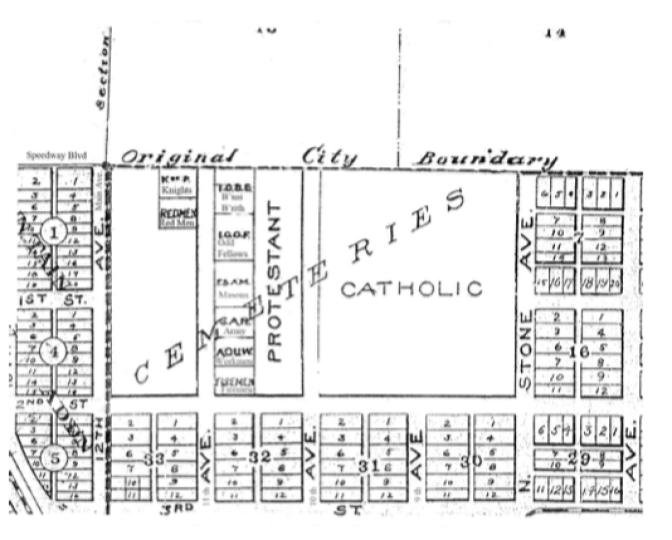
*A map of the Court Street Cemetery drawn in 1906 by J. B. Wright, city engineer. Courtesy of Todd A. Pitezel. From the Tucson Fire Foundation’s study on historic graves of firemen at the Court Street Cemetery.
All photos, with the exception of the map of The Court Street Cemetery* and the Tucson Citizen newspaper clipping**, were taken by Shannon Fojtik for the purposes of this article.
Shannon Fojtik can be reached at fojtiks@gmail.com.
